The diagnostics problem
A report such as “the internet is slow” does not identify the faulty point. The cause may be Wi-Fi signal, roaming between access points, packet loss, DNS, a captive portal, an HTTP service, the WAN link or a temporary issue that has disappeared by the time investigation starts.
Infracheck separates two complementary perspectives. The phone measures what the user sees at that moment, while the local appliance can run repeated checks from the network. Correlating them provides more context than a single capture or a delayed test.
The Android application
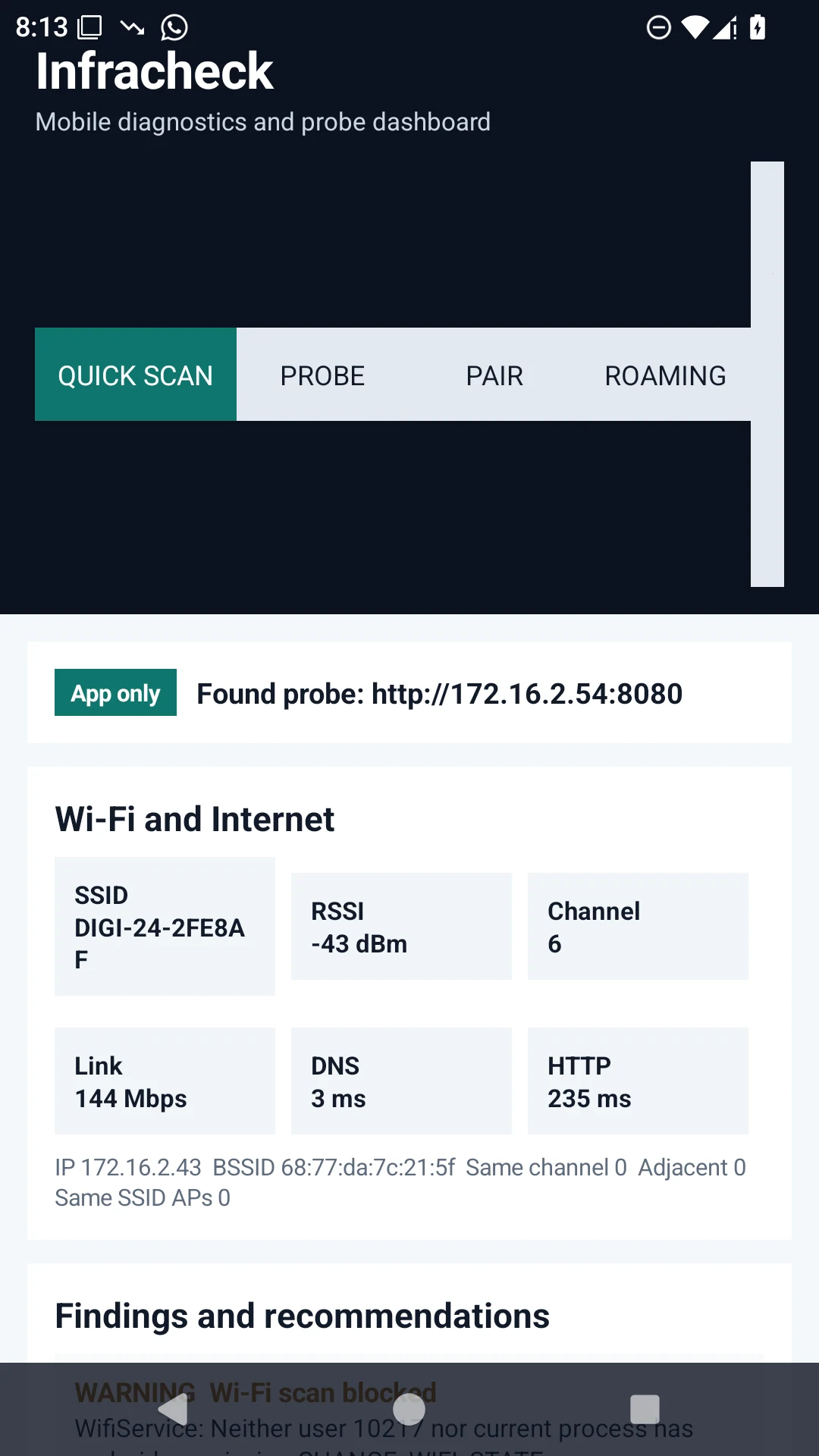
Published mobile capabilities include Quick Scan, Wi-Fi Live, roaming checks, DNS, HTTP, captive portal detection and public IP. These tests are designed to collect indicators that can be communicated to a technical team.
From a mobile-development perspective, the product combines device and network information with an interface that needs to remain clear during an investigation. Permissions, Android-version differences and network states are functional requirements rather than later details.
The optional local appliance
The local component is available as a Docker appliance and can add ping, DNS, HTTP, TLS, WAN and packet-loss checks, LAN inventory, alerts, reports and history. Deployment inside the observed network provides a stable measurement point independent of the user's phone.
The modular architecture keeps the application useful by itself, while the appliance extends the product for organizations requiring monitoring. An optional premium central portal can aggregate data where multiple locations or central administration are required.
What the project demonstrates
- Android mobile development and integration with device network information;
- containerized local services and Docker deployment;
- monitoring, time-series history, alerts and reports;
- communication between an application, appliance and optional central services;
- product design that explains technical data to different users.
These capabilities transfer to IT/Telecom support projects, applications for technical teams and products that combine software with local infrastructure.
Limits explained correctly
A diagnostic tool cannot replace administrative access to every device or operator dataset. It can provide better evidence, identify patterns and reduce investigation time, but conclusions still need to reflect topology and system ownership.
The same boundary matters in custom projects: we define what the application can observe, what it can control and what remains with infrastructure or external suppliers.
Do you need diagnostics, monitoring or a dedicated technical tool?
We can review locations, measurement points, alerts and integrations and propose Infracheck or an implementation adapted to your process.
Discuss your project